Article 11 EU AI Act: Technical Documentation Explained
- cici BEL
- Apr 29
- 10 min read

Your AI system works. It passes internal tests. Your team is confident. But can you prove — on paper, to a regulator — that it meets every requirement the EU AI Act sets out?
That is what Article 11 demands. Not a product description. Not a slide deck. A comprehensive technical documentation that demonstrates compliance with every requirement in Chapter 2 of the AI Act — before your system reaches the market. Article 11 turns your compliance work into evidence. And Annex IV tells you exactly what that evidence must contain: 9 chapters, each covering a specific dimension of your system. From system architecture to post-market monitoring, from risk management to change history — nothing is optional.
This guide breaks down every element. What each chapter requires, where the cross-references lead, and what the SME simplification actually means in practice.
What Is Article 11?
Article 11 of the EU AI Act (Regulation 2024/1689) establishes the obligation for providers of high-risk AI systems to create and maintain technical documentation. The core requirement sounds straightforward, but the details matter.
Three principles define Article 11:
First: timing. The technical documentation must be completed before placing the system on the market or putting it into service. Retroactive documentation is not permitted. If your system is live without complete documentation, you are already non-compliant.
Second: purpose. The documentation is not a description of your system. It is a compliance demonstration. Article 11(1) explicitly states that the documentation must demonstrate that the system meets the requirements of Chapter 2 (Articles 9–15). Authorities and notified bodies must be able to assess conformity based on this document alone.
Third: continuity. The documentation must be kept up to date throughout the entire lifecycle of the system. Every change to the system that affects compliance triggers an obligation to update the corresponding sections.
The minimum content is defined in Annex IV — 9 mandatory chapters that every provider must address. These are the floor, not the ceiling.
Who Needs to Comply?
Article 11 applies specifically to providers of high-risk AI systems as classified under Article 6. Three conditions must all be met:
Your AI system is classified as high-risk under Article 6. You are the provider (the entity that develops or places the system on the market) — not the deployer. And you are placing the system on the EU market or putting it into service within the EU.
If you are a deployer (operator), your obligations fall under Articles 26 and 27 — not Article 11. If your system is not classified as high-risk, Article 11 does not apply.
Not sure whether your system is high-risk?
The classification depends on Article 6 and Annex III. Use the TrustTroiAI
Scope Check (Troi) to find out in minutes: trusttroiai.com
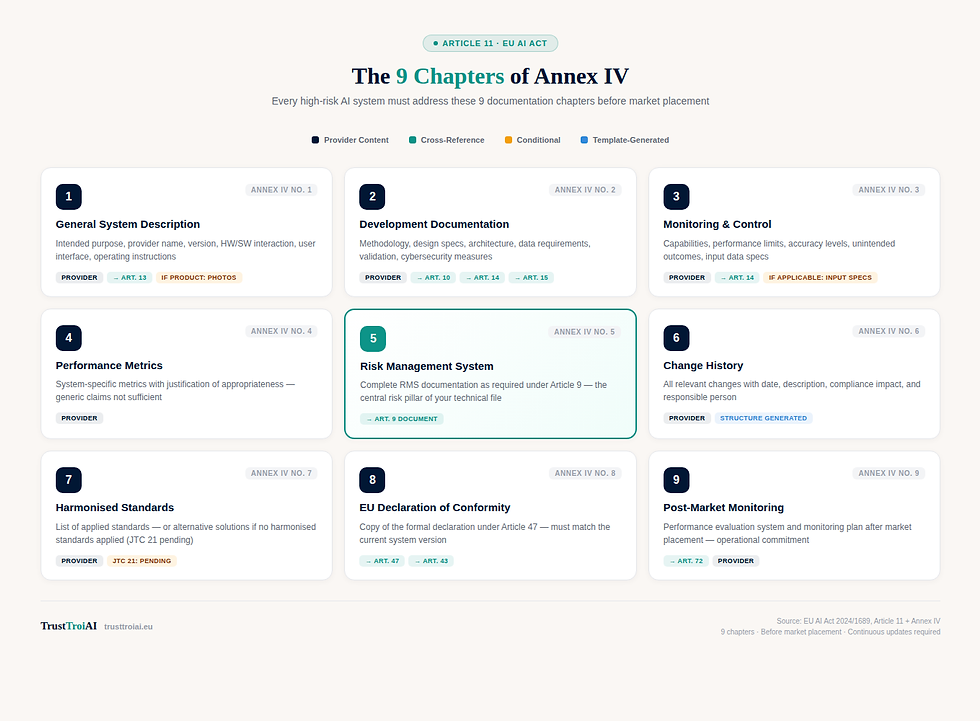
The 9 Chapters of Annex IV
Annex IV is the backbone of Article 11. It defines the minimum content of the technical documentation across 9 numbered sections. Each section has a specific focus — and many reference other AI Act articles directly.
Here is what each chapter requires:
1. General System Description (Annex IV No. 1)
This is the foundation of your documentation. It must include the intended purpose of the system, the provider's name, and the system version. Beyond that, you need to describe how the system interacts with hardware and software, document all relevant software and firmware versions (including update requirements), describe all forms in which the system is placed on the market, and specify the hardware the system needs to run.
If the AI system is a component of a physical product, photographs or illustrations are required. Every system needs a basic description of the user interface. And finally, you must include operating instructions for the deployer — which can reference your Article 13 transparency document.
2. Development Documentation (Annex IV No. 2)
This chapter requires a detailed account of how the system was built. The development methodology and steps must be documented, along with design specifications covering the general logic, algorithms, and key design decisions. A description of the system architecture is mandatory.
If the system involves machine learning training, data requirements must be documented in the form of datasheets — this connects directly to your Article 10 data governance work. The assessment of human oversight measures required under Article 14 must be included, and any pre-determined changes to the system must be described if applicable.
Validation and testing procedures need to be documented (linking to Articles 9 and 15), along with all cybersecurity measures implemented (linking to Article 15).
3. Monitoring and Control (Annex IV No. 3)
Detailed information about the system's capabilities and performance limits, including accuracy levels, must be provided. You need to describe foreseeable unintended outcomes and sources of risk, the human oversight measures as required under Article 14, and — where applicable — specifications for input data.
This chapter answers the question: what can your system do, what can it not do, and what could go wrong?
4. Performance Metrics (Annex IV No. 4)
A description of the appropriateness of the performance metrics for the specific AI system. The key word here is specific — generic metrics are not sufficient. You need to explain why the chosen metrics are appropriate for your particular system and its intended purpose.
5. Risk Management System (Annex IV No. 5)
A detailed description of the risk management system as required under Article 9. This is where your Article 9 documentation becomes a direct component of the technical file. If you have completed your Article 9 work, this chapter references or includes that document.
Already completed Article 9?
Your risk management documentation feeds directly into Annex IV Chapter 5. Read our Article 9 guide for the full breakdown.
6. Change History (Annex IV No. 6)
A description of all relevant changes the provider has made throughout the system's lifecycle. Every change must be documented with a date, description, and responsible person. This is not a changelog in the software development sense — it is a compliance record that tracks how the system evolved after being placed on the market.
7. Harmonised Standards (Annex IV No. 7)
A list of all harmonised standards applied. If no harmonised standards have been applied, you must describe the alternative solutions used to meet the requirements.
As of April 2026, the final harmonised standards for the AI Act are still being developed by CEN-CENELEC JTC 21. This means providers currently cannot fully complete this chapter. The alternative: document the solutions you have implemented to fulfil the requirements, and update this section once JTC 21 standards are published.
8. EU Declaration of Conformity (Annex IV No. 8)
A copy of the EU Declaration of Conformity as required under Article 47. This is a formal document that must be current and consistent with the documented system version.
9. Post-Market Monitoring (Annex IV No. 9)
A detailed description of the system for evaluating performance after market placement, as required under Article 72. This includes the post-market monitoring plan — how you will track the system's behaviour, collect feedback, and identify issues once it is deployed in the real world.
The SME Track: Simplified Documentation
Article 11(1) includes an important provision for small and medium-sized enterprises. SMEs and startups (under 250 employees) may present the Annex IV content in simplified form, using a dedicated form that the European Commission is required to create.
There are three things to understand about this provision:
The simplification is real but bounded. SMEs can reduce the level of detail in their documentation — particularly in the technically dense chapters like development documentation (No. 2) and monitoring (No. 3). However, the topical coverage must remain complete. All 9 Annex IV sections must still be addressed. You can write less, but you cannot skip sections.
Notified bodies must accept the simplified form. This is a legal obligation under Article 11(1). A notified body that refuses the SME form for a conformity assessment would be acting unlawfully.
The form does not exist yet. As of April 2026, the European Commission has not published the simplified SME form. This creates a practical gap: SMEs know they have the right to simplify, but do not yet know the exact format. The recommendation is to begin with a full Annex IV structure at reduced detail depth, and switch to the official form once it becomes available.
SME Form Status (April 2026)
The simplified documentation form for SMEs has not yet been published by the European Commission. TrustTroiAI will update its templates as soon as the official form becomes available.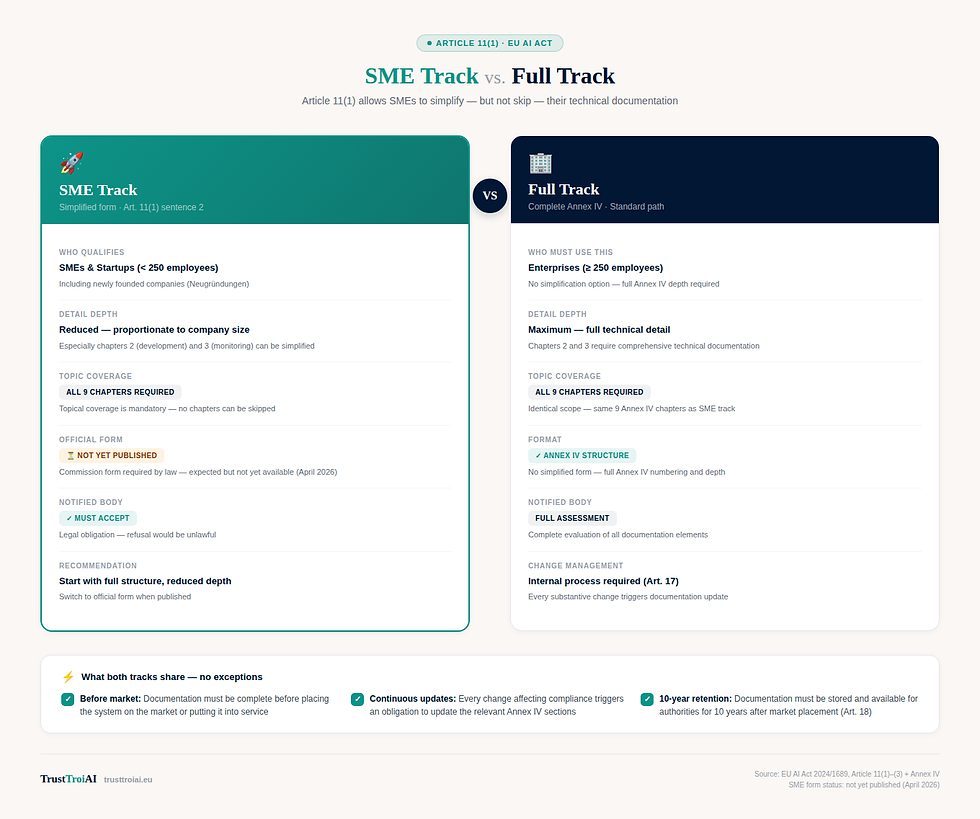
Product Integration: The Single Documentation Rule
Article 11(2) addresses a specific scenario: what happens when the AI system is a component of a product that falls under existing EU harmonisation legislation listed in Annex I Section A — such as the Medical Devices Regulation (MDR 2017/745) or the Machinery Regulation.
The rule is clear: one single technical file. Providers must create a combined document that includes both the Annex IV requirements from the AI Act and the documentation requirements from the applicable product legislation. No separate documents, no parallel files.
In practice, this means coordination. Content that is relevant to both frameworks — such as risk analysis under ISO 14971 for medical devices — is documented once and referenced in both contexts. The notified body under the product legislation (for example, the MDR notified body) also assesses the AI Act compliance aspects within this combined file.
The Cross-Reference Web
Article 11 is not a standalone obligation. Annex IV directly references 9 other AI Act articles, making it the documentation hub of the entire regulation. Understanding these connections is essential for efficient compliance work.
Annex IV Section | References | What It Pulls In |
No. 1(h) — Operating Instructions | → Art. 13 | Transparency and information for deployers |
No. 2(d) — Data Requirements | → Art. 10 | Data governance and training data documentation |
2(e) — Human Oversight Assessment | → Art. 14 | Human oversight measures and evaluation |
No. 2(g) — Validation & Testing | → Art. 9 + Art. 15 | Risk management testing + accuracy/robustness |
No. 2(h) — Cybersecurity | → Art. 15 | Cybersecurity measures |
No. 3 — Monitoring & Oversight | → Art. 14 | Human oversight in operational context |
No. 5 — Risk Management | → Art. 9 | Complete RMS documentation |
No. 8 — Declaration of Conformity | → Art. 47 | Formal EU conformity declaration |
No. 9 — Post-Market Monitoring | → Art. 72 | Post-market monitoring system and plan |
Beyond Annex IV, Article 11 connects to two further articles: Article 17 (Quality Management System), which requires the technical documentation to be integrated into the QMS, and Article 18 (Document Retention), which mandates 10 years of retention after market placement.
The practical consequence: if you build your Article 9, 10, 13, 14, and 15 documentation first, large parts of Annex IV are already covered. Article 11 assembles the pieces into a single compliance file.

Three Pitfalls to Avoid
Pitfall 1: Retroactive Documentation
The most common mistake is treating documentation as something you do after launch. Article 11(1) is explicit: the technical documentation must be completed before placing the system on the market or putting it into service. If your system is already live and the documentation is incomplete, you need to address this immediately.
Pitfall 2: Static Documents
Many teams treat the technical file as a one-time deliverable — created for the conformity assessment and then archived. Article 11(1) requires continuous updates. Every change to the system that affects its compliance status triggers an obligation to update the corresponding Annex IV sections. This requires an internal change management process, not just a document.
Pitfall 3: Description Instead of Demonstration
The documentation is not a product brochure. Article 11(1) explicitly states that it must demonstrate that the system meets the requirements. Authorities and notified bodies must be able to assess conformity based on this document. That means evidence, not claims. Test results, not promises. Traceable risk mitigation, not general statements.

Open Questions: What Is Still Missing
Honest assessment: Article 11 leaves several questions open as of April 2026.
The SME form is still missing. Article 11(1) gives SMEs the right to simplified documentation, but the Commission has not yet published the required form. Until it does, SMEs operate in a grey zone — entitled to simplify, but without an official format.
Harmonised standards are still in development. CEN-CENELEC JTC 21 is developing the harmonised standards for the AI Act, but final versions have not been adopted. This means Annex IV No. 7 cannot be fully completed yet. Providers should document their current compliance approach and plan to update once standards are published.
Delegated acts could change the rules. Article 11(3) grants the Commission the power to amend Annex IV through delegated acts under Article 97. This means the documentation requirements themselves could change. Providers should monitor regulatory developments and be prepared to adapt.
These are not reasons to wait. They are reasons to build a flexible documentation structure that can absorb updates.
How TrustTroiAI Helps
TrustTroiAI provides a guided template for Article 11 technical documentation that covers all 9 Annex IV chapters. The workflow is structured around 8 guided questions (Q1–Q8) that capture the key information about your system — from intended purpose and risk classification to system architecture and deployment model.
Based on your answers, the template generates a structured DOCX document that maps directly to Annex IV numbering. Sections that connect to other articles (Art. 9, Art. 10, Art. 13, Art. 14, Art. 15) are clearly marked as cross-references. Conditional sections — like product integration photography or pre-determined changes — are included or excluded based on your answers.
Every section that requires provider-specific technical content is marked as "to be completed by provider." The template does not fabricate technical details — it provides the structure, the regulatory references, and the guided workflow. Your team provides the substance. And when you are ready, Bruno (our expert validation layer) can review the completeness of your documentation before submission.
Start your Article 11 documentation today
TrustTroiAI's guided template walks you through all 9 Annex IV chapters — from system description to post-market monitoring.
→ Start your documentation: trusttroiai.com
Key Takeaways
→ Article 11 requires comprehensive technical documentation before your high-risk AI system reaches the market — not after.
→ Annex IV defines 9 mandatory chapters covering everything from system description to post-market monitoring. These are the legal minimum.
→ The documentation must demonstrate compliance, not just describe your system. Authorities must be able to assess conformity from this document alone.
→ SMEs can simplify the level of detail but must still address all 9 topics. The official simplified form has not yet been published.
→ Article 11 is the documentation hub — Annex IV directly references Articles 9, 10, 13, 14, 15, 47, and 72. Building those first makes Article 11 significantly easier.
Source
1. EU AI Act 2024/1689, Article 11 — Technical Documentation
2. EU AI Act 2024/1689, Annex IV — Technical Documentation Requirements
VERWANDTE ARTIKEL:
3. EU AI Act 2024/1689, Articles 9, 10, 13, 14, 15, 17, 18, 43, 47, 72, 97
STANDARDS:
4. CEN-CENELEC JTC 21 — Harmonised Standards for the AI Act (in development, as of April 2026)


Comments