Compliance That Actually Lands: Why the Future Is Decentralised
- Joe Simms
- Apr 10
- 8 min read
Policy sent. E-learning completed. Quiz done.
And then? Nothing.
Or almost nothing. The policy sits unread in the inbox. The quiz gets clicked through in under three minutes. And the next day, everything continues exactly as before.
This is not a fictional scenario. Research published in the Compliance Manager confirms what many practitioners already sense: employees forget up to 80% of what they learn in one-off training sessions within just a few days. The result is high effort, low impact — and a growing gap between what organisations think they've communicated and what actually shapes behaviour.
But here is what rarely gets said out loud: this is not a communication problem. It is a structural one. And structural problems require structural answers.
The Real Problem: Compliance Was Designed for Departments That No Longer Run the Show
The traditional compliance model has a clear mental image behind it: a dedicated team, a policy library, a training calendar. A compliance officer who sends, and employees who receive.
That model made sense in a world where decisions — especially risky ones — were concentrated. Where a single legal or compliance function could realistically review every relevant choice before it was made.
That world no longer exists for most organisations. Certainly not for startups. Certainly not for fast-moving product teams.
Today, compliance-relevant decisions are made in sprint planning. In feature reviews. In vendor onboarding calls. In customer conversations. In the fifteen minutes before a developer merges a pull request.
No compliance officer is in the room for any of that.
Meanwhile, the EU is raising the stakes dramatically. The EU AI Act, GDPR, NIS2 — taken together, these are not incremental updates to existing rules. They represent a fundamental shift in what it means to build and operate AI-powered products in Europe. The obligations are real, the deadlines are firm, and the penalties for non-compliance are substantial.
The gap between compliance as it is traditionally designed and compliance as it actually needs to work has never been wider.
The Decentralised Reality: Who Actually Makes Compliance Decisions?
Ask a Product Manager, a CTO, or the founder of a ten-person startup whether they make compliance decisions, and most will say no.
Ask them how they decide whether to add a feature that processes biometric data, whether to integrate a third-party AI model, or whether their new recruitment tool falls under the EU AI Act — and the answer changes. Every one of those decisions is a compliance decision. They are just not framed that way.
This is the decentralised reality of modern compliance. The people actually making the calls are not lawyers. They are not compliance officers. They are PMs, CTOs, developers, and founders who encounter compliance as an unexpected blocker — not as a planned activity.
And when they hit that blocker, they have limited options: wait for legal (days or weeks), guess (risky), or skip it (dangerous). None of these is a good answer.
What they need is a fourth option: a way to get a clear, reliable, contextual answer — right now, in their workflow, without a law degree.
Enter the Compliance Champion
The Compliance Champion is not a new job title. It is a new capability.
A Compliance Champion is a Product Manager, CTO, or founder who can navigate compliance questions with confidence — not because they are legal experts, but because they have the right tool at the right moment.
This is not about replacing lawyers. It is about ensuring that the vast majority of routine compliance decisions — the ones that happen every day in every sprint, every standup, every feature review — do not require a lawyer at all. And that when expert judgment genuinely is needed, it arrives with full context and can be acted on immediately.
The concept draws on something the Compliance Manager describes as the "compliance rhythm": the insight that compliance works not through volume and noise, but through brevity, repetition, and context. The right piece of information, at the right moment, in the format the person can actually use.
TrustTroiAI was built around exactly that idea — starting from the real situation of the people who carry compliance responsibility without the compliance job title.
How TrustTroiAI Enables the Compliance Champion
Step 1 — Know What Applies: Troi's Scope Check
The first barrier for any Compliance Champion is often the most basic one: not knowing which regulations apply at all.
The EU AI Act alone runs to 180 articles and 13 annexes. GDPR adds another layer. NIS2 another. For someone whose primary job is building a product — not reading regulatory texts — knowing where to start is genuinely non-trivial.
Troi, TrustTroiAI's scope module, solves this in seconds. Describe your project — what it does, who it interacts with, which data it processes — and Troi identifies the applicable regulations with their confidence scores and the specific legal basis that triggers each one.

In the example above, Troi identifies both GDPR and the EU AI Act as applicable to Nova Voice, a customer service voice bot — and explains why each regulation applies, citing the specific articles and the facts about the project that trigger them. No guesswork. No waiting for legal.
The Compliance Champion now has a clear picture of the regulatory landscape for their project. That is not a small thing. It is the foundation everything else builds on.
Step 2 — Understand It Without a Law Degree: Finn's Cool Mode
Knowing which regulations apply is step one. Understanding what they actually require — in practical terms, actionable terms, human terms — is step two.
This is where most compliance tools leave people behind. They surface the legal text. They cite the article. They may even highlight the relevant passage. And then they leave you with something like:
"Pursuant to Art. 9(2)(a) of Regulation (EU) 2024/1689, providers shall establish, implement, document and maintain a risk management system consisting of a continuous iterative process run throughout the entire lifecycle of a high-risk AI system."Accurate. Useless.
Finn, TrustTroiAI's AI assistant, has a different approach. And Cool Mode is where it becomes visible.
Switch to Cool Mode, and the same obligation reads differently: what do you actually need to build, document, and maintain — explained the way a knowledgeable colleague would explain it, not the way a regulation is written.
Cool Mode does not dumb compliance down. It translates it.There is a difference. The legal substance stays intact. What changes is the format — from legislative language to working language.
For a Compliance Champion, this is the difference between a compliance answer they understand and can act on immediately, and one they will need to forward to someone else. Speed of decision, compressed from days to minutes.
Finn also goes further. When a compliance obligation raises a specific question — "why does Art. 50 apply to our system?" — Finn explains the connection between the regulation and the specific facts of the project.
This is not generic legal information. It is compliance intelligence, grounded in the actual project. The Compliance Champion can walk into any meeting — any standup, any board review, any investor call — and answer the compliance question.
Step 3 — Compliance in Your Sprint: The Jira Export (Coming Q2 2026)
Scope is clear. Obligations are understood. Now comes the question that turns compliance insight into compliance action: how do you actually get it done?
The traditional answer: create a compliance task, assign it somewhere, hope it doesn't get buried.
The answer we are building: imagine opening Jira on a Monday morning and finding your entire EU AI Act compliance roadmap already broken down into sprint-ready tickets — each obligation mapped to the relevant article, each ticket with a deadline, each task assigned based on the type of work required.
That is exactly what the Jira Export feature will deliver, launching Q2 2026. Assessment results become Jira Epics. Individual obligations become Stories. Deadlines, labels, and acceptance criteria are pre-populated. The Compliance Champion does not need to translate compliance language into project management language — TrustTroiAI does it automatically.
Coming Q2 2026: Jira Export transforms TrustTroiAI assessment results into fully structured Epics, Stories, and Sub-Tasks — with deadlines, priority labels, and acceptance criteria. Compliance lives in your sprint, not in a separate tool.Why does this matter? Because compliance that is not in the sprint does not happen. It is not a question of intention — it is a question of where attention goes. The Compliance Champion's tool of work is Jira. When compliance obligations appear there, they exist in the Champion's world. When they don't, they remain in a system nobody opens
Step 4 — When You Need a Human: Bruno's Expert Validation
Not every compliance question has a self-service answer. Some situations — pre-launch sign-off, investor due diligence, regulatory audit preparation — require more than AI analysis. They require a qualified human expert, with accountability, willing to put their name on the outcome.
This is Bruno's territory.
Bruno is TrustTroiAI's expert validation module: a structured workflow that connects the AI-powered assessment to a legal expert review, producing a signed, formal compliance report. Not hours of billable legal work from scratch — a scoped, efficient review of a structured AI assessment, focused on the gaps and edge cases that genuinely require expert judgment.
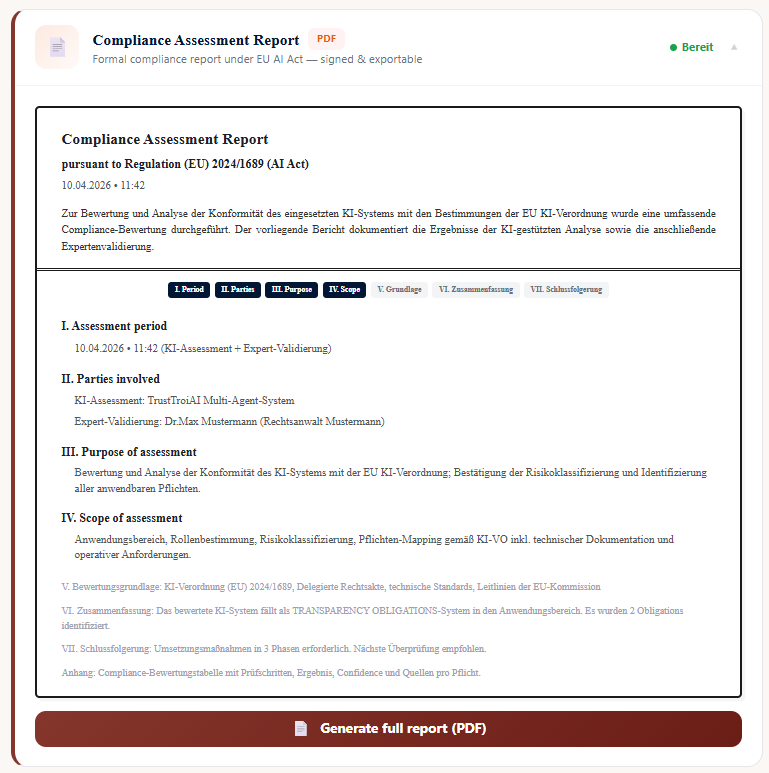
The result is a document that holds. It cites the applicable articles, maps them to the project's specific facts, and carries the dual signature of the AI assessment platform and the legal expert. Clear accountability. No grey areas.
This is the moment where "AI analyses, humans decide, experts validate" becomes a concrete deliverable — not just a philosophy.
The Compliance Champion does not need to be the expert. They need to know when expert validation is required, and they need a path to get there that does not consume weeks of time or tens of thousands of euros. Bruno provides that path.
What "Compliance That Lands" Actually Looks Like
The Compliance Manager is right that compliance works through rhythm — brevity, repetition, context. What TrustTroiAI adds is the infrastructure that makes rhythm possible for teams who do not have a compliance department.
The before and after is concrete:
Before:A new regulation applies. Somebody sends a PDF. It sits in an inbox. Three months later, somebody asks whether the team is compliant. Nobody knows.
After: Troi identifies the regulation in seconds. Finn explains what it requires in language the PM can use. The obligations land in Jira as sprint tickets. Bruno validates when the stakes require it.
Compliance does not arrive as a lecture or a campaign. It arrives as a useful answer at the moment it is needed — in the standup, in the feature review, in the sprint. That is what it means to land.
The Compliance Champion is not a heroic individual carrying an impossible burden. They are a capable professional with the right tools — tools that translate, contextualise, and integrate compliance into the work that is already happening.
Compliance is your right, not just your duty.
Find out in five minutes which EU regulations apply to your AI project — free, no login required.
→ Start your Scope Check at
Comments